

Continuous Penetration Testing
Continuous penetration testing moves away from fixed testing cycles and treats security as an ongoing process.
Instead of a one-off assessment, testing becomes part of a programe.
Combining automated coverage, human validation, and ongoing prioritization.
It answers a different question:
What’s changed, what matters now, and what do we fix next?
What defines it
- Testing runs continuously, not once per year
- Coverage adapts as environments change
- Findings are validated and re-tested over time
- Prioritization evolves as context changes, not just at assessment point
- Results are delivered through a live platform, not a static report
But more importantly:
- Issues are continuously monitored as exploitability changes
- New exploits are tracked as they emerge
- Active exploitation in the wild is factored into prioritization
Annual Penetration Testing
Annual penetration testing follows a more traditional model.
Scope is defined. Testing happens over a fixed period. Results are delivered in a report.
In many cases, annual testing is driven by compliance.
It satisfies a requirement, but it doesn’t necessarily reflect how risk is managed day to day.
Where it works
- Supporting audits and certifications
- Establishing a baseline
- Meeting regulatory requirements
Where it falls short
- It reflects a single point in time
- New assets and vulnerabilities are missed
- There’s limited visibility between tests
- Fixes aren’t consistently validated over time
Annual testing can absolutely include context and prioritization.
The challenge is that it’s captured at that moment.
Outputs are typically delivered in PDFs, spreadsheets, or static portals.
As soon as the environment changes, that context starts to drift.
The Key Difference
The key difference is that continuous penetration testing is an ongoing program that adapts to change, while annual penetration testing is a static, point-in-time assessment.
| Continuous Testing | Annual Testing |
|---|---|
| Ongoing program | Point-in-time assessment |
| Real-time visibility | Snapshot view |
| Adapts to change | Fixed scope |
| Exploit-led prioritization | Static prioritization |
| Platform-based delivery | Report-based delivery |
Annual testing tells you where you were.
Continuous testing shows you where you are and where attackers will go next.
Why this shift is happening
Environments have changed.
- Infrastructure isn’t static
- Applications are released continuously
- Attack surfaces are expanding
- Exploits are developed and shared quickly
Attackers don’t wait for your next test.
They operate continuously.
Scanning. Probing. Exploiting.
A once-a-year assessment can’t reflect that reality.
Continuous testing isn’t about doing more testing.
It’s about keeping pace with change.
A practical example
A large retail client shared a penetration test from the previous year as a starting point.
When reassessed under a continuous model:
- Some vulnerabilities had changed in context
- New exposures had appeared
- Attack paths that didn’t exist before were now viable
The original report wasn’t wrong, it just wasn’t relevant anymore.
Risk had moved on.
How Rootshell approaches continuous testing
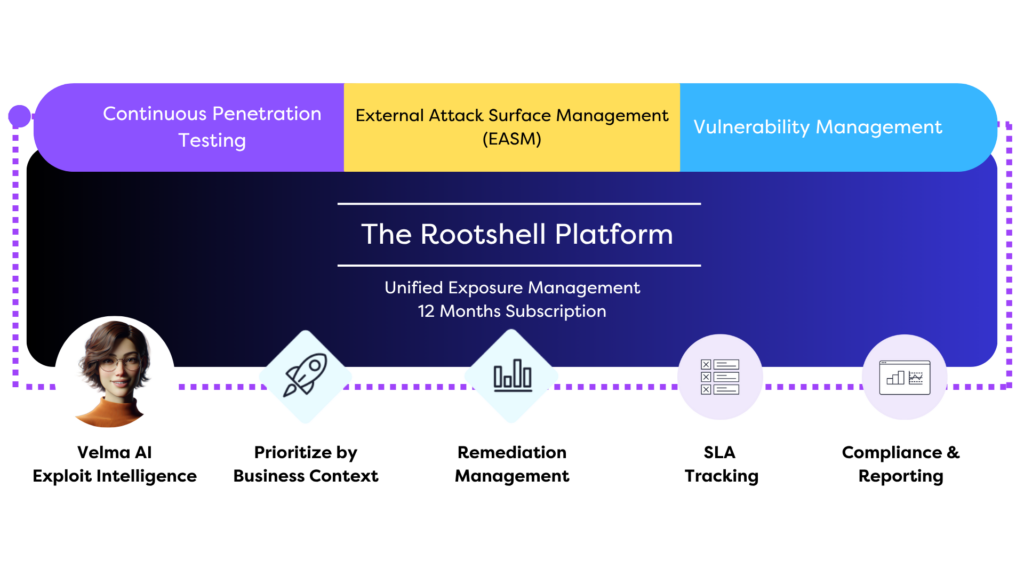
At Rootshell, continuous penetration testing is delivered as a programe, not a standalone service.
Testing, exploit intelligence, and attack surface visibility are brought together into a single workflow.
What that looks like
Continuous assessment
Automated and manual testing working together over time.
Exploit-led prioritization (Velma)
Vulnerabilities are enriched with real-world intelligence to identify what is actually exploitable and active.
Attack surface visibility (ASM)
Continuous discovery of unknown and unmanaged assets.
Detection of malicious or lookalike domains.
Identification of unknown but non-malicious exposures.
Monitoring for breached credentials linked to the organization.
Because the biggest risks aren’t always the vulnerabilities you know about.
They’re often the assets you didn’t know existed.
Centralized visibility
All findings across testing, scanning, and attack surface monitoring in one place with The Rootshell Platform.
Automation and response
Rules can be created to automatically take action as context changes.
Reprioritization based on new exploit intelligence.
Automatic ticket creation and updates in systems like Jira.
Reducing the delay between insight and remediation.
Dynamic remediation
Issues are tracked, owned, and validated continuously.
Vendor-neutral approach
Third-party tools and testing outputs consolidated into a single view
The focus isn’t on generating more findings. It’s on reducing everything down to the small number of issues that actually represent risk.
Across both known vulnerabilities and unknown exposures.
And making sure they get fixed.
Insight without action is just noise.
The value is in how quickly you can turn that insight into remediation.
When continuous penetration testing makes sense
Continuous testing becomes important when:
- Environments change frequently
- Visibility across assets is limited
- Teams are overwhelmed by volume
- Prioritization is unclear
- There’s a need to demonstrate ongoing assurance
For most clients, it’s not about replacing annual testing completely.
It’s about closing the gap between those points in time.
Conclusion
Annual penetration testing still has its place.
But it was designed for a different environment.
Today:
- Risk is continuous
- Attackers are continuous
- Change is continuous
Security needs to reflect that.
Continuous penetration testing gives you a practical way to understand, prioritise, and reduce risk as it evolves, not just report on it after the fact.