

Will AI Replace Penetration Testers? Why Human-Led AI Testing Is the Future of Security Testing
Human-Led AI Testing combines AI-powered security analysis with experienced penetration testers to deliver broader coverage, better context, and more effective risk prioritization.
Over the last 12 months, the cybersecurity industry has seen an explosion of AI-powered security products.
Vulnerability scanners, attack surface management platforms, exposure validation tools, and penetration testing vendors are all racing to incorporate Large Language Models (LLMs) into their offerings.
The direction of travel is clear: AI will identify more vulnerabilities, more quickly, and across larger environments than ever before.
Rootshell has embraced this reality and already uses AI-driven capabilities alongside commercially available tooling as part of its Continuous Penetration Testing approach.
Rather than viewing AI as a replacement for penetration testers, Rootshell believes the future lies in combining artificial intelligence with experienced security professionals.
The result is Human-Led AI Testing: an approach that combines AI-powered analysis, continuous visibility, and experienced penetration testers to deliver more effective security outcomes.
What Is Human-Led AI Testing?
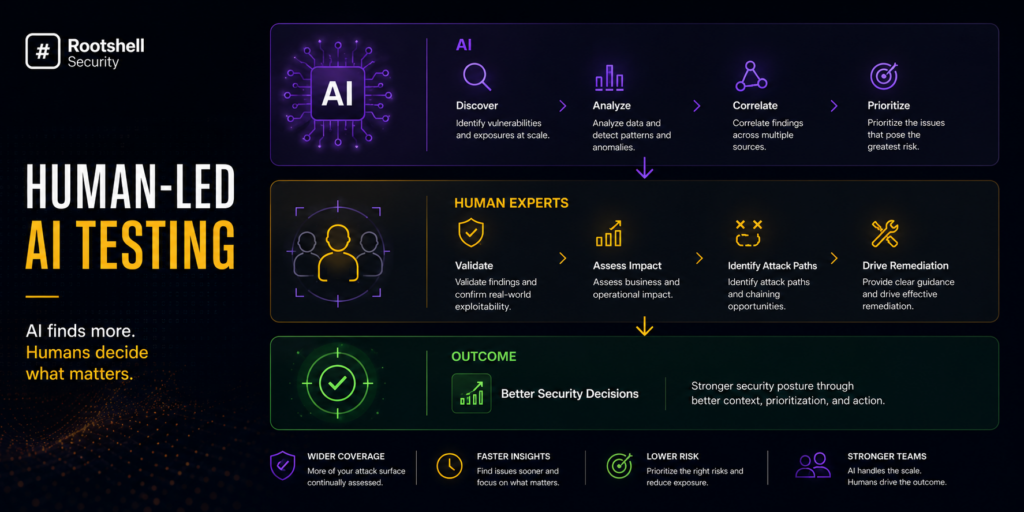
Human-Led AI Testing combines AI-powered discovery, analysis, validation, and continuous monitoring with the expertise of experienced penetration testers.
Rather than replacing security professionals, Human-Led AI Testing uses AI to increase scale and coverage while allowing consultants to focus on the work that requires human judgment, creativity, and experience.
AI can rapidly process large volumes of information, identify patterns, highlight potential attack paths, and continuously analyze security data. Human testers then provide the context, creativity, and real-world judgment needed to determine what actually matters.
The combination delivers broader coverage, faster identification of exposures, and more meaningful security outcomes than either approach could achieve independently.
As AI capabilities continue to evolve, organizations will increasingly benefit from security testing that combines machine-scale analysis with human expertise.
According to the OWASP Top 10 for Large Language Model Applications, organizations must now consider entirely new categories of risk, including prompt injection, insecure output handling, and sensitive information disclosure.
AI as the World’s Largest Graduate Program
A useful way to think about AI in cybersecurity is through the following analogy.
Imagine having access to some of the most capable cybersecurity graduates available anywhere in the world.
They’re intelligent.
They’re fast.
They can process vast amounts of information.
They never sleep.
They can work on multiple tasks simultaneously.
However, like most graduates, they still lack the experience required to make critical judgment calls.
They can identify patterns, anomalies, and potential vulnerabilities, but they do not yet possess the real-world experience needed to understand business context, assess true risk, or think creatively like an experienced penetration tester.
AI is an incredibly powerful member of the team. But it still benefits from the guidance, oversight, and expertise of experienced security professionals.
The best outcomes occur when AI and humans work together.
Why Continuous Testing Changes the Equation
Traditional penetration testing has always faced a simple challenge.
A consultant can only assess so much within a finite period of time. Even the best penetration testers must make decisions about where to focus their effort.
AI changes this dynamic.
This is where Human-Led AI Testing becomes particularly powerful. AI can continuously analyze environments and identify potential exposures, while experienced testers focus on validating risk, identifying attack paths, and understanding real-world impact.
By incorporating AI-powered tooling into testing methodologies, organizations can increase coverage across environments and continuously analyze findings throughout the testing lifecycle.
This allows consultants to spend less time on repetitive activities and more time focusing on the work that genuinely requires expertise:
- Understanding business context
- Identifying attack paths
- Validating exploitability
- Assessing real-world impact
- Prioritizing remediation
- Thinking like an attacker
The result is a more comprehensive and more relevant assessment.
What AI Does Well in Security Testing
AI is already proving highly effective at:
- Processing large volumes of security data
- Identifying patterns and anomalies
- Correlating findings across multiple sources
- Highlighting potential attack paths
- Prioritizing exposures for review
- Continuously analyzing environments at scale
These capabilities help security teams discover more issues and gain broader visibility across their environments.
Where Human Penetration Testers Remain Essential
Despite rapid advances, AI still has limitations.
Experienced penetration testers remain critical for:
- Understanding organizational and business context
- Thinking creatively like an attacker
- Identifying complex attack chains
- Validating exploitability
- Assessing operational and business impact
- Communicating risk effectively to stakeholders
- Prioritizing remediation based on real-world risk
Security testing is not simply about finding vulnerabilities.
It’s about understanding which vulnerabilities matter and why.
That requires experience, judgment, and human insight.
The Industry Is Only Getting Started
The market appears largely aligned on one thing: everyone is investing heavily in AI.
The major vulnerability management, scanning, and security testing vendors are all developing capabilities that leverage their preferred AI models and platforms.
This creates a genuine opportunity for organizations looking to gain better visibility of their security posture.
Over the coming months and years, AI-powered security tooling is expected to uncover significantly more vulnerabilities than traditional approaches alone.
This is not because environments are becoming less secure.
It is because the ability to discover and analyze weaknesses is improving dramatically.
Why Exposure Management Matters More Than Ever
As security teams begin receiving more findings from more sources, consolidation becomes increasingly important.
This is one of the reasons Rootshell has invested heavily in the Rootshell Platform.
Exposure management capabilities allow organizations to consolidate information from multiple security sources, including:
- Vulnerability scanners
- Attack Surface Management
- Penetration testing results
- Exploit intelligence feeds
Rather than reviewing findings across multiple disconnected platforms, organizations can gain a single view of risk across their environment.
As vulnerability volumes increase, this unified approach becomes even more important.
The objective is not simply to generate more findings.
It is to understand which findings actually matter.
For organizations adopting Human-Led AI Testing, exposure management becomes the mechanism that turns large volumes of security data into prioritized, actionable remediation plans.
This aligns closely with the principles of Continuous Threat Exposure Management, where organizations continuously identify, validate, prioritize, and remediate exposures across their attack surface.
The Next Phase: AI as a Security Team Member
Looking ahead, the opportunity extends well beyond testing.
Rootshell’s MCP Server is currently progressing toward beta, and exploration is underway into how AI can interact with security data in a more meaningful way.
Potential use cases include:
- AI security analysts reviewing an organization’s entire security estate
- AI agents identifying attack paths across multiple technologies
- Continuous analysis of new vulnerabilities and exposures
- Context-aware security recommendations
- Automated threat modelling
- Security assistants trained on an organization’s specific environment
The real value emerges when AI has access to a unified security dataset and can analyze relationships that would otherwise require significant manual effort.
The Future of Human-Led AI Testing
The future of Human-Led AI Testing is not AI replacing security professionals.
It is AI augmenting experienced security teams so they can identify, validate, and remediate risk more effectively than ever before.
At the same time, security teams will increasingly use AI as part of the team itself, helping to analyze environments, identify attack paths, and support decision-making.
The organizations that gain the greatest advantage will be those that combine:
- AI-powered detection and testing capabilities
- Experienced security practitioners
- Unified exposure management
- Continuous visibility of risk
Why Human-Led AI Testing Matters
Organizations are facing an increasing volume of vulnerabilities, exposures, and security alerts.
Human-Led AI Testing helps security teams keep pace by combining the scale and speed of AI with the expertise and judgment of experienced penetration testers.
The result is broader visibility, better prioritization, more effective remediation, and ultimately stronger security outcomes.
Final Thought
The technology will evolve quickly.
The fundamentals will not.
Getting the issues that matter in front of the right people as quickly as possible so remediation can happen remains the objective.
Everything else supports that.
Frequently Asked Questions
Will AI replace penetration testers?
No. AI can improve efficiency, scale, and coverage, but experienced penetration testers remain essential for validating findings, understanding business context, assessing risk, and identifying complex attack paths.
What is Human-Led AI Testing?
Human-Led AI Testing is a security testing approach that combines AI-powered discovery, analysis, and continuous monitoring with experienced penetration testers who validate findings, assess business impact, and prioritize remediation.
What are the benefits of AI in penetration testing?
AI can process large volumes of data, identify patterns, continuously analyze environments, and help security teams discover exposures more efficiently.
For organizations looking to test AI systems themselves, see the AI Penetration Testing Service.
What are the limitations of AI security testing?
AI lacks business context, real-world experience, creativity, and judgment. Human expertise remains essential for determining which vulnerabilities genuinely pose risk to an organization.
Can’t find the answer to your question?
You can always Contact Our Team of experts for a chat!